What Does Question 4 Ask You to Do?
Question 4 usually presents a statement about the impression created by the writer.
For example:
"A student said: 'The writer successfully creates a frightening atmosphere throughout this section.'"
To what extent do you agree?
This question is asking you to evaluate how successfully the writer creates the impression described.
You should consider:
-
Whether you agree with the statement.
-
Which details create the impression.
-
How the writer uses language and structure.
-
How the reader might respond.
-
Whether the impression changes as the extract develops.
You can agree, disagree or partly agree. There is no requirement to agree with the statement. What matters is whether you develop a convincing interpretation and support it with appropriate evidence.
How to Answer AQA Paper 1 Question 4: Five Steps
A strong Question 4 response needs a clear argument, relevant evidence and detailed evaluation. Follow these five steps when practising.
Step 1: Read the statement carefully
Before writing, identify the main idea in the statement.
For example:
"The writer successfully creates a frightening atmosphere throughout this section."
Think about:
-
What atmosphere does the statement describe?
-
Do you agree with this impression?
-
Does the atmosphere change as the extract develops?
-
Are there details that support or challenge the statement?
Underline the key words in the statement. These will help you maintain focus throughout your answer.
Step 2: Read the specified lines carefully
Question 4 directs you to a particular section of the source. Read those lines carefully and avoid relying on evidence from outside the specified section.
Look for:
-
Powerful words and phrases.
-
Descriptions of characters and settings.
-
Changes in mood or atmosphere.
-
Interesting language choices.
-
Structural developments.
-
Details that create a particular impression.
Try to select evidence from different points in the section. This will help you develop an argument about how the writer creates an impression across the extract.
Step 3: Develop your own judgement
Your answer should make your opinion clear.
A basic response might say:
"The writer uses descriptive language to create tension."
This identifies a general effect but does not fully evaluate the writer's success.
A more developed response might say:
"The writer creates a convincing sense of tension by gradually revealing details about the character's surroundings. This makes the reader increasingly uneasy because the danger appears to be developing rather than arriving suddenly."
The second example explains why the writer's approach is effective.
Use evaluative phrases naturally:
-
The writer successfully creates...
-
This is particularly effective because...
-
The description encourages the reader to...
-
The contrast makes the moment more...
-
This reinforces the impression that...
-
The writer gradually develops...
-
This could suggest that...
Do not use these phrases mechanically. Your explanation and evidence are more important than impressive-sounding vocabulary.
Step 4: Explain the writer's methods and effects
Use this paragraph structure to develop your ideas:
Point → Evidence → Method → Effect → Evaluation
-
Point: State your interpretation.
-
Evidence: Select a relevant quotation.
-
Method: Identify an interesting language or structural choice.
-
Effect: Explain what the reader might think or feel.
-
Evaluation: Judge how successfully the writer creates the impression.
For example:
"The description of the house as having windows 'staring blankly into the darkness' makes the setting appear threatening. The personification gives the building an almost human quality, as though it is watching the character. This creates an unsettling impression before anything frightening has actually happened."
You do not need to identify a technique in every sentence. Focus on explaining the writer's choices and evaluating their effectiveness.
Step 5: Build a clear overall argument
Aim for three or four developed paragraphs rather than many short, repetitive points.
A strong response should:
-
Establish a clear judgement.
-
Use relevant evidence throughout the specified section.
-
Explore language and structural choices.
-
Explain how the reader's impression develops.
-
Finish with a clear overall evaluation.
Your conclusion should bring your main ideas together. Avoid introducing an entirely new quotation or repeating the introduction word for word.
What Does a Grade 9-Style Question 4 Answer Look Like?
The best way to understand evaluation is to see it in practice.
Let's use an original practice extract and question.
Read the following short extract:
The house stood at the end of the narrow lane, its windows staring blankly into the darkness. Daniel slowed as he approached the gate. Somewhere inside, a floorboard creaked. He stopped. The sound came again, closer this time. His hand tightened around the cold metal latch, but he could not bring himself to open it. Behind the upstairs curtain, a shadow shifted. For a moment, everything became silent. Then the front door began to open, inch by inch.
Practice Question 4
A student said:
"The writer successfully creates a growing sense of fear and suspense as Daniel approaches the house."
To what extent do you agree?
In your response, you could:
-
Consider your own impressions of the atmosphere.
-
Evaluate how the writer creates a sense of fear and suspense.
-
Support your response with references to the extract.
[20 marks – original practice question]
Grade 9-style model answer
I strongly agree that the writer creates a growing sense of fear and suspense as Daniel approaches the house. Rather than revealing an immediate threat, the writer gradually introduces unsettling details, encouraging the reader to share Daniel's uncertainty and anticipate that something frightening is about to happen.
Initially, the description of the house as having windows "staring blankly into the darkness" creates an unsettling impression. The personification of the windows makes the building seem almost alive, as though it is watching Daniel. The word "blankly" also suggests an absence of warmth or welcome, making the setting appear hostile. This is particularly effective because the house is presented as more than an ordinary building; it becomes an intimidating presence that immediately makes the reader uneasy.
The tension develops further when Daniel hears a floorboard creak. The sound is repeated through the phrase "the sound came again", suggesting that something is moving inside the house. The fact that the sound appears to become "closer" intensifies the threat because neither Daniel nor the reader knows what is approaching. The writer deliberately withholds an explanation, allowing the reader's imagination to create possibilities that may be even more frightening than the reality.
Daniel's physical reaction also reinforces the growing suspense. His hand "tightened around the cold metal latch", suggesting that his fear is affecting his ability to act. The adjective "cold" contributes to the uncomfortable atmosphere, while his inability to open the gate reveals the strength of his hesitation. This makes the moment particularly convincing because the reader can understand his fear through his actions rather than being directly told that he is frightened.
The final image of the front door opening "inch by inch" provides the strongest sense of suspense. The slow movement suggests that something is deliberately approaching, while the preceding silence makes the action even more unsettling. The writer ends the extract without revealing who or what is behind the door. This unresolved ending leaves the reader anticipating danger and makes the atmosphere of uncertainty particularly effective.
Overall, I strongly agree with the statement. The writer successfully builds suspense through personification, sound, physical reactions and a gradual sequence of unsettling events. Most importantly, the threat remains unexplained, allowing the reader to experience the same uncertainty and growing fear as Daniel.
Important: This is an illustrative Grade 9-style response to an original practice extract. It is not an official AQA-marked answer or a guaranteed Grade 9 response.
Why Is This a Strong Answer?
The model answer demonstrates several important evaluation skills.
| Skill |
How the answer demonstrates it |
| Clear judgement |
Establishes agreement with the statement. |
| Relevant evidence |
Uses quotations from across the extract. |
| Language analysis |
Explores personification and word choices. |
| Structural awareness |
Explains how tension develops towards the ending. |
| Reader response |
Considers uncertainty, anticipation and fear. |
| Evaluation |
Explains why the writer's choices are effective. |
| Overall argument |
Returns to the statement in the conclusion. |
Notice that the answer does not simply identify techniques. It explains how the writer uses them to develop an impression and influence the reader.
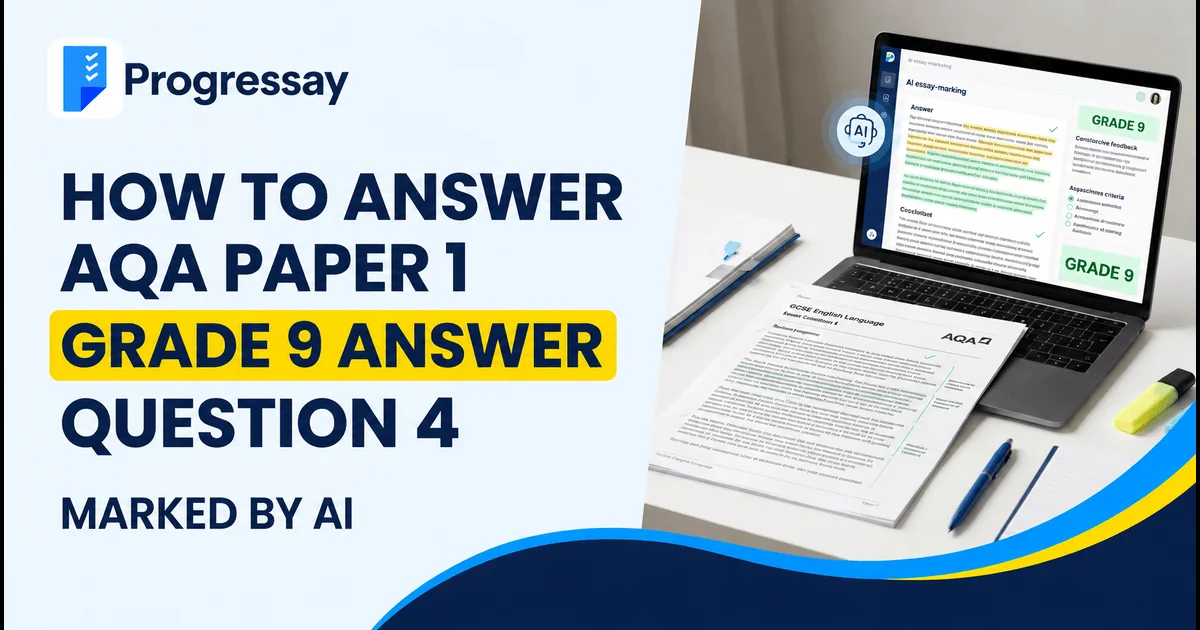
How Can AI Help Mark Your AQA Paper 1 Question 4 Answer?
Writing an answer is only one part of revision. You also need to understand what you have done well and which areas need improvement.
An AI grading tool can provide additional feedback on your response by reviewing:
-
Whether your answer addresses the statement.
-
Whether your judgement is clear and developed.
-
Whether you use relevant quotations.
-
Whether you explain the writer's methods.
-
Whether you evaluate the effect on the reader.
-
Whether your paragraphs develop a convincing argument.
AI feedback can help you identify weaknesses that you might overlook when checking your own work.
Example: AI feedback on the model answer
The following is an illustrative example of the type of feedback an AI grading tool could provide. It is not an official AQA mark or examiner decision.
Overall assessment: Strong, developed evaluation.
What the answer does well:
-
Maintains a clear and consistent judgement.
-
Selects relevant evidence from different parts of the extract.
-
Explains how language choices create an unsettling atmosphere.
-
Recognises how the writer gradually develops suspense.
-
Connects the writer's methods to the reader's response.
What could be improved further:
-
Explore more than one possible interpretation of selected details.
-
Develop the relationship between the opening description and the unresolved ending.
-
Make some evaluative comments more precise rather than repeating that the writing is effective.
Suggested improvement: Consider how the writer controls the amount of information revealed to the reader. Explain why withholding the identity of the figure makes the ending more suspenseful.
AI feedback should be treated as a learning aid, not a guaranteed GCSE grade. Always compare your work with the relevant AQA mark scheme and assessment guidance.
A useful AI prompt for practising Question 4
You can use the following prompt to receive structured feedback on your own practice response.
Copy this prompt:
"Act as a GCSE AQA English Language examiner and revision tutor. Review my answer to AQA GCSE English Language Paper 1 Question 4.
Assess my response using the AO4 focus: evaluate texts critically and support your evaluation with appropriate textual references.
Please:
-
Identify the strengths of my evaluation.
-
Check whether I have maintained a clear judgement.
-
Review how effectively I have selected and used quotations.
-
Explain whether I have analysed the writer's language and structural choices.
-
Evaluate how well I have explained the reader's response.
-
Identify where my analysis is repetitive or descriptive rather than evaluative.
-
Suggest specific improvements to help me develop a stronger response.
-
Rewrite one paragraph to demonstrate a more developed evaluation.
Do not invent an official AQA mark or guarantee a GCSE grade. Clearly distinguish your feedback from an official examiner assessment.
Here is the question, extract and my answer:
[Paste the question, extract and your answer here.]"
You can also practise other reading and writing questions using our AQA GCSE English Language Paper 1 course.
Common Mistakes to Avoid in Question 4
Students can miss opportunities to demonstrate their evaluation skills by making these common mistakes.
1. Retelling the story
Do not spend your answer explaining what happens in the extract. Focus on how successfully the writer creates the impression described in the question.
2. Using quotations without explanation
A quotation alone does not demonstrate evaluation. Explain why the selected words or details support your judgement.
3. Ignoring the statement
Keep returning to the statement throughout your answer. Every main point should contribute to your overall argument.
4. Writing about the wrong section
Use the lines specified in the question. Evidence outside that section will not support your response to the stated focus.
5. Naming techniques without evaluating them
Identifying personification, metaphor or adjectives is not enough. Explain how the writer's choices shape the reader's understanding or response.
6. Repeating the same point
Avoid writing several paragraphs that all say the atmosphere is frightening. Develop different aspects of the writer's methods and show how the effect changes.
Avoid vague statements such as "the reader feels scared". Explain why a particular word, description or structural choice could create that reaction.
8. Using complicated vocabulary without clear analysis
High-level writing does not mean using unnecessarily complicated words. Accurate explanations, thoughtful interpretations and relevant evidence are more important.
How to Practise AQA Paper 1 Question 4
The best way to improve is to practise with different extracts and question statements.
Use this revision routine:
-
Choose an AQA GCSE English Language Paper 1 past paper.
-
Read the extract and identify the section specified in Question 4.
-
Highlight evidence that supports or challenges the statement.
-
Write a clear judgement before developing your paragraphs.
-
Complete your response in approximately 20 minutes.
-
Review your answer against the relevant mark scheme.
-
Use AI feedback to identify areas for improvement.
-
Rewrite one paragraph using the feedback.
-
Repeat the process with a different extract.
Practise with AQA GCSE English Language Past Papers
Past papers help you become familiar with the exam format and practise applying your skills to unfamiliar extracts.
Use Progressay's AQA past papers collection to find available revision resources and practise your exam skills.
Explore AQA GCSE English Language past papers.
When practising, pay attention to the question wording and the specific lines you are asked to evaluate. Do not simply memorise model answers; learn how to apply the evaluation method to different texts.
How to Prepare for the Other AQA English Language Questions
Question 4 is only one part of Paper 1. To prepare effectively, you should understand how all five questions work and practise each assessment skill.
-
Question 1: Select information from the specified part of the source.
-
Question 2: Analyse how the writer uses language.
-
Question 3: Analyse how the writer structures the text.
-
Question 4: Evaluate the text and support your judgement with evidence.
-
Question 5: Produce a piece of descriptive or narrative writing.
For more support with creative writing, read our guide: How Do I Get Grade 9 in AQA English Language Paper 1 Question 5?.
You can also prepare for the second exam paper with our guide: How to Answer AQA GCSE English Language Paper 2 Questions: Tips and Examples.
Improve Your Exam Technique with Progressay's AQA Paper 1 Course
If you want more structured support, Progressay offers a complete AQA GCSE English Language Paper 1 course.
The course includes seven modules covering:
-
Paper 1 structure and Assessment Objectives.
-
Question 1 reading comprehension.
-
Question 2 language analysis.
-
Question 3 structural analysis.
-
Question 4 evaluation and evidence.
-
Question 5 creative writing.
-
Past-paper practice.
The dedicated Question 4 module covers question breakdowns, model answers and techniques for supporting your ideas with evidence.
Whether you are working towards a Grade 5, Grade 7 or Grade 9, regular practice and detailed feedback can help you understand your strengths and identify areas to improve.
Explore the AQA GCSE English Language Paper 1 Full Course on Progressay.
Frequently Asked Questions
How many marks is AQA Paper 1 Question 4 worth?
Question 4 is worth 20 marks and assesses AO4: evaluating texts critically and supporting your evaluation with appropriate textual references.
How long should I spend on Question 4?
Aim for approximately 20 minutes. This gives you time to read the relevant section, select evidence, plan your argument and write a developed response.
Do I have to agree with the statement?
No. You can agree, disagree or partly agree. Your judgement must be supported by relevant evidence from the specified section of the extract.
How many paragraphs should I write for Question 4?
Three or four developed paragraphs can provide a useful structure. Focus on the quality of your evaluation rather than trying to reach a particular paragraph count.
Do I need to analyse language techniques in Question 4?
You should explore the writer's choices and explain how they contribute to the impression being evaluated. This may include language, structure and other relevant methods.
Can I get Grade 9 in AQA Paper 1 Question 4?
A Grade 9 response requires thoughtful evaluation, relevant evidence and clear explanations of the writer's choices. There is no single formula that guarantees a Grade 9, so practise applying these skills to different extracts.
Can AI mark my AQA English Language Paper 1 Question 4 answer?
AI tools can provide feedback on your judgement, evidence, analysis and evaluation. However, AI-generated marks are estimates and should not be treated as official AQA grades.
Where can I find AQA GCSE English Language past papers?
You can explore Progressay's AQA past papers collection to find available AQA exam resources for revision and practice.
What is the difference between Paper 1 and Paper 2?
Paper 1 focuses on creative reading and writing using a literary fiction extract. Paper 2 focuses on writers' viewpoints and perspectives in non-fiction and literary non-fiction texts.
You can learn more in our guide to AQA GCSE English Language Paper 2 questions.
Final Revision Advice
To improve your AQA GCSE English Language Paper 1 Question 4 performance, focus on developing a clear judgement, selecting precise evidence and evaluating how the writer creates meaning.
Do not just identify language techniques. Explain why the writer uses them, how they influence the reader and how successfully they support the statement.
Practise with different AQA past-paper extracts, review your answers and use AI feedback to identify areas for improvement.
For structured preparation across the full paper, explore the Progressay AQA GCSE English Language Paper 1 course and continue practising with AQA past papers.