
How to Answer AQA GCSE English Language Paper 2 Questions: Tips and Examples
Struggling with AQA GCSE English Language Paper 2? The key to improving your answers is understanding what each question assesses, selecting relevant evidence from the texts and explaining your ideas clearly.
AQA GCSE English Language Paper 2 is called Writers' Viewpoints and Perspectives. It asks you to explore two non-fiction or literary non-fiction texts, compare the writers' viewpoints and write your own response to a related issue.
In this guide, you'll learn how to approach the reading questions, compare writers effectively and improve your writing, with practical examples and revision tips.
Want to practise with real exam questions? Start with free GCSE past papers on Progressay.
What Is AQA GCSE English Language Paper 2?
AQA GCSE English Language Paper 2 focuses on writers' viewpoints and perspectives.
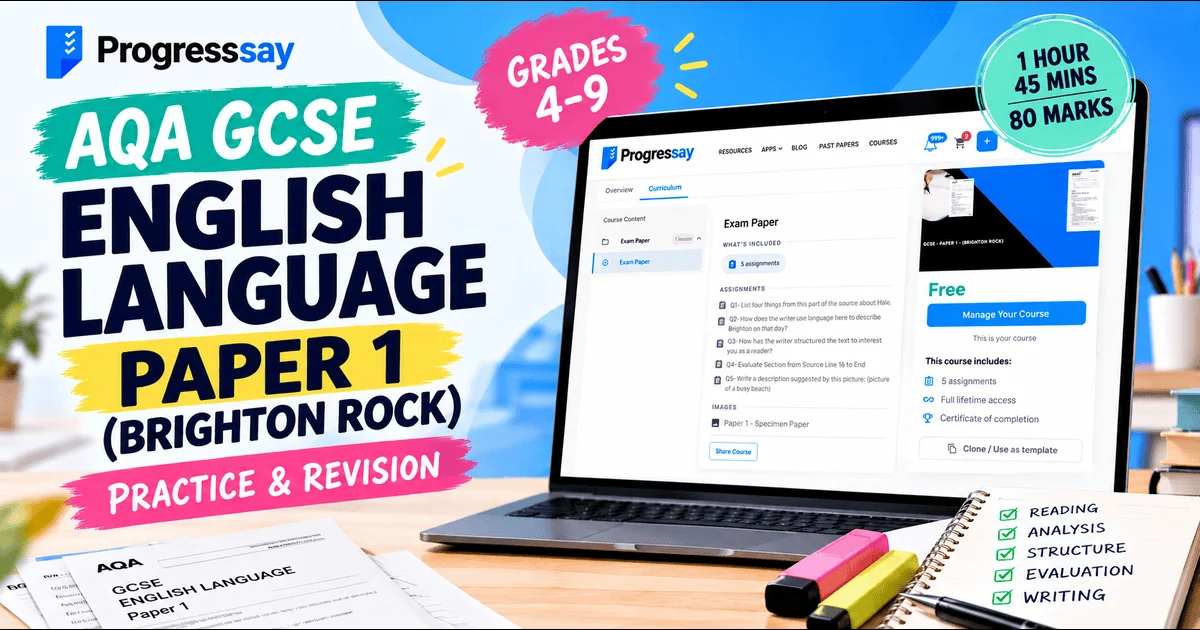
The exam lasts 1 hour 45 minutes and is worth 80 marks, representing 50% of the GCSE English Language qualification.
It has two sections:
-
Section A: Reading (40 marks): Answer questions about two linked non-fiction or literary non-fiction texts.
-
Section B: Writing (40 marks): Write your own response to a task related to the topic, expressing a viewpoint.
For the current specification, check the latest official AQA assessment information before revising, as assessment materials and question formats can change.
How to Answer AQA GCSE English Language Paper 2 Questions
The best approach is to identify the skill each question tests before you begin writing. Use the marks available to guide how much detail you include, and always follow the exact wording of the question.
Question 1: Select the Correct Information
Question 1 tests your ability to identify information from a specified source. It is a short question, so accuracy matters more than lengthy explanation.
How to answer it:
-
Read the instructions carefully.
-
Find the relevant part of the specified text.
-
Select only the information that meets the question's requirements.
-
Check each answer before moving on.
Example: If the question asks you to select four statements that are true according to Source A, return to the source and verify every choice. Do not add information from your own knowledge.
Tip: Avoid spending too long on this question. Secure the available marks and move on.
Question 2: Make Inferences and Summarise Information
Summary questions require you to select relevant information and show what you understand from the text. Depending on the wording, you may need to make inferences rather than simply copy details.
How to answer it:
-
Identify the exact focus of the question.
-
Select relevant evidence from the specified source or sources.
-
Explain what the details suggest.
-
Keep your response focused on the question.
Example: Imagine a writer describes a crowded station as noisy, uncomfortable and difficult to navigate.
Instead of simply listing these details, you could explain that the station appears overwhelming because the noise and congestion make it difficult for people to move comfortably.
This shows how evidence can support an interpretation.
Tip: Use your own words where appropriate, and avoid retelling the whole text.
Question 3: Analyse the Writer's Language
Language analysis asks you to explain how a writer uses words and phrases to create an effect or communicate an idea.
Look beyond identifying a technique. Explain why the writer's specific language choices matter.
A useful structure:
-
Make a clear point about the writer's language.
-
Select a short quotation.
-
Analyse a specific word or phrase.
-
Explain the effect or impression it creates.
Example: Imagine a writer describes a storm as “raging across the coastline”.
You could write:
The verb “raging” presents the storm as powerful and aggressive. It suggests that the weather is difficult to control, creating a sense of danger for anyone near the coastline.
This answer identifies a word, explains its meaning in context and links it to an effect.
Tip: Avoid listing techniques without explaining them. A thoughtful analysis of a short quotation can be more effective than identifying several devices without discussing their impact.
Question 4: Compare the Writers' Viewpoints and Perspectives
Comparison is an important skill in Paper 2. You need to compare what the writers think or feel and explain how they communicate their viewpoints.
How to structure your answer:
-
Identify a similarity or difference between the writers.
-
Support your point with evidence from both texts.
-
Explain how each writer communicates their perspective.
-
Compare the language or structural choices where relevant.
Example: Imagine one writer describes a mountain climb as an exciting challenge, while another describes a similar experience as frightening.
You could explain that the first writer presents the climb positively by emphasising achievement and excitement, whereas the second focuses on danger and uncertainty. Their contrasting word choices reveal different attitudes towards the same type of experience.
This is stronger than writing a separate summary of each text because it directly compares the perspectives.
Tip: Use comparative phrases naturally, such as “whereas”, “in contrast”, “similarly” and “both writers”. Make sure every comparison is supported by the texts.
Question 5: How to Write a Strong Viewpoint Response
The writing task asks you to present your own viewpoint in a specified form, for a particular audience and purpose. The task may ask you to write a speech, article, letter or another form of non-fiction writing.
Before writing, identify:
-
Audience: Who will read or hear your response?
-
Purpose: Are you arguing, persuading, explaining or discussing?
-
Form: What type of writing does the task require?
-
Viewpoint: What is your main argument or position?
Example topic: “Should schools give students less homework?”
A clear opening might be:
Homework should have a purpose, not simply fill students' evenings. Although independent practice can help learners develop their skills, excessive homework can leave young people exhausted and with little time for other important activities.
This opening establishes a viewpoint, recognises another side of the argument and introduces reasons that could be developed in the rest of the response.
To improve your writing:
-
Organise your ideas into clear paragraphs.
-
Use relevant examples to support your argument.
-
Vary sentence structures for emphasis.
-
Use persuasive techniques when they suit your purpose.
-
Maintain a consistent tone for your audience.
-
Check spelling, punctuation and grammar.
For AQA's current Paper 2 writing assessment, content and organisation are worth 24 marks, while technical accuracy is worth 16 marks. Check the latest specification and mark scheme for the assessment you are preparing for.
How to Manage Your Time in Paper 2
Paper 2 lasts 1 hour 45 minutes, so planning your time helps you give each question appropriate attention.
A possible starting plan is:
| Activity | Suggested time |
|---|---|
| Read both sources and the questions | 15 minutes |
| Question 1 | 5 minutes |
| Question 2 | 10 minutes |
| Question 3 | 15 minutes |
| Question 4 | 20 minutes |
| Question 5: plan, write and check | 40 minutes |
These are suggested timings, not official AQA requirements. Adjust them to your strengths and the precise question format on your paper. Leave a little time to check your writing.
Common Mistakes to Avoid
Retelling instead of analysing: Explain how a quotation communicates a viewpoint or creates an effect.
Forgetting to compare both writers: Make direct comparisons and support them with evidence from both texts.
Using long quotations without explanation: Choose concise, relevant evidence and analyse it carefully.
Ignoring the task instructions: Check the audience, purpose and form before writing your response.
Skipping proofreading: Reserve time to correct spelling, punctuation and grammar.
Practising without reviewing: Completing papers is useful, but reviewing your answers helps you identify what to improve next.
Practise With Free GCSE English Past Papers
Reading tips is a good starting point, but you also need to apply them to real exam questions.
On Progressay, you can explore past papers and available mark schemes, practise the question types and review your answers. Start with the papers that match your exam board and specification.
Explore free GCSE past papers on Progressay
When you finish a paper, compare your answers with the relevant mark scheme. Identify where your evidence, analysis or comparison could be stronger, then practise those skills again.
Want More Structured Paper 2 Practice?
If you want step-by-step guidance rather than revising each question independently, Progressay offers a dedicated AQA GCSE English Language Paper 2 course.
The course includes guidance on the exam, explanations of how to approach the questions, examples of model answers and AI marking for submitted responses. It is designed to help you practise the skills needed for Paper 2 and review your work.
Practise with the full AQA GCSE English Language Paper 2 course
The course is listed at £4.99. Check the course page for the latest price and details.
Frequently Asked Questions
How do I get better at AQA GCSE English Language Paper 2?
Practise each question type, use relevant quotations, explain your interpretations and compare writers directly when required. Review your answers against the appropriate mark scheme and focus your next revision session on your weakest skill.
What is the difference between Paper 1 and Paper 2?
AQA Paper 1 focuses on creative reading and writing using a fiction text. Paper 2 focuses on writers' viewpoints and perspectives using two linked non-fiction or literary non-fiction texts, followed by a viewpoint-based writing task.
How do you compare two writers in Paper 2?
Identify a clear similarity or difference in their viewpoints, select evidence from both texts and explain how each writer communicates their perspective. Compare their methods where relevant instead of analysing each text separately.
How many marks is AQA GCSE English Language Paper 2?
Paper 2 is worth 80 marks and represents 50% of the GCSE English Language qualification. The paper includes reading and writing assessments.
Where can I practise AQA GCSE English Language Paper 2 questions?
You can explore Progressay's past-paper collection and the official AQA assessment resources. For structured guidance and AI-marked practice, you can also use Progressay's full Paper 2 course.
Prepare for Your AQA English Language Exam With Progressay
The most effective revision combines understanding the questions, practising under timed conditions and learning from feedback.
Start with free past papers, work on the question types you find difficult and review your answers carefully. When you're ready for more structured support, Progressay's Paper 2 course provides question-by-question guidance and AI-marked practice.