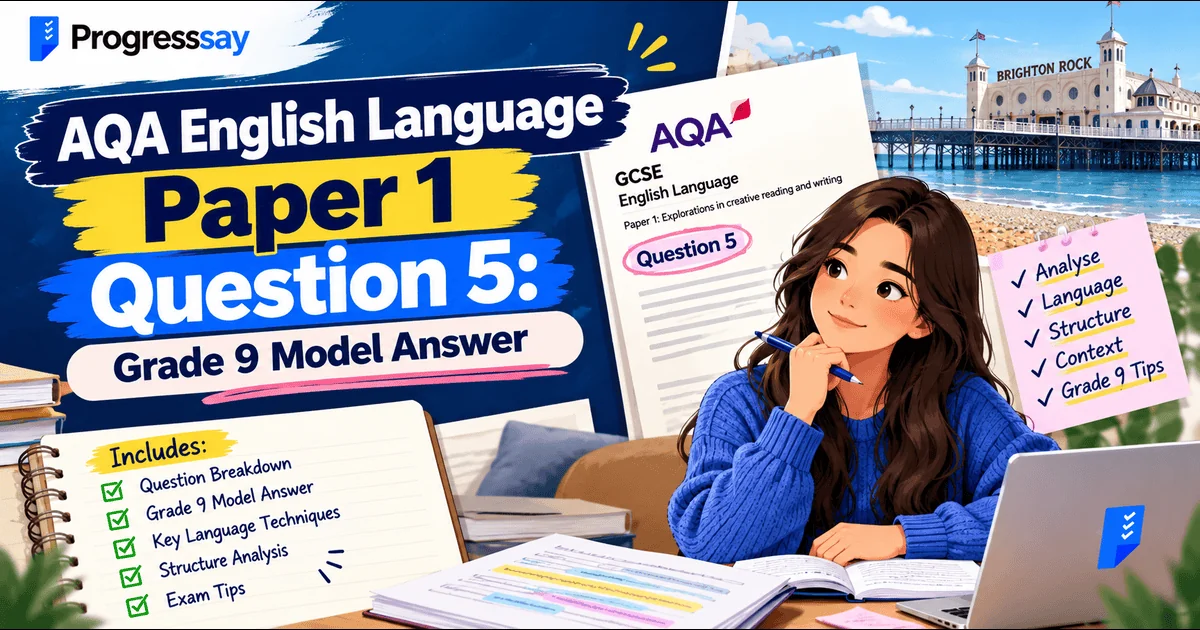
AQA English Language Paper 1 Question 5: Grade 9 Model Answer
If you're preparing for AQA English Language Paper 1 Question 5, you may be wondering what a Grade 9 answer actually looks like.
Question 5 is the creative writing task on AQA GCSE English Language Paper 1. It is worth 40 marks, with 24 marks for content and organisation and 16 marks for technical accuracy.
The good news is that you don't need to use complicated words in every sentence to achieve a high mark. A strong answer needs clear ideas, effective vocabulary, deliberate structure and accurate writing.
What Is AQA English Language Paper 1 Question 5?
Question 5 is the creative writing section of AQA GCSE English Language Paper 1.
Depending on the paper, you may be asked to:
-
Write a description based on a picture or scenario
-
Write a description from your imagination
-
Write the opening of a story
The task tests your ability to communicate effectively, organise your ideas and use vocabulary, sentence structures and punctuation appropriately.
Because Question 5 is worth 40 marks, it is an important part of your Paper 1 preparation.
What Does a Grade 9 Answer Need?
A Grade 9 response should demonstrate control rather than simply trying to sound complicated.
Focus on these five areas.
1. Strong Ideas
Give the reader something interesting to imagine.
Instead of describing everything you can see, choose details that create a particular atmosphere.
2. Deliberate Structure
Your writing should take the reader somewhere.
A simple structure could be:
Introduce the setting → Zoom in → Develop the atmosphere → Introduce a change → Create a memorable ending
You don't have to follow this exact structure every time. The important thing is that your writing feels organised and purposeful.
3. Precise Vocabulary
Don't use unusual words just because they sound impressive.
Choose words that create the exact effect you want.
For example:
Basic:
The wind moved through the trees.
More effective:
The wind clawed through the branches.
The second sentence creates a stronger image and gives the wind a more threatening quality.
4. Varied Sentence Structures
Use a mixture of sentence lengths.
Longer sentences can help build description, while short sentences can create emphasis.
For example:
The street stretched into the distance, empty and silent beneath the grey afternoon sky.
Nothing moved.
The short sentence creates a pause and changes the rhythm.
5. Accurate Writing
Technical accuracy is worth 16 marks, so spelling, punctuation and grammar matter.
Don't sacrifice accuracy because you're trying to sound sophisticated.
Grade 9 Model Answer: Creative Description
Imagine the question asks:
Write a description of a busy seaside town.
Model Answer
The town was already awake.
By nine o'clock, the narrow streets had filled with noise. Children raced towards the beach, their voices rising above the clatter of café chairs and the distant cry of gulls. Somewhere behind the row of colourful shops, a door slammed.
The sea waited at the end of the road.
It glittered beneath the morning sun, stretching endlessly towards the horizon. Waves rolled towards the shore, folding over themselves before collapsing into white foam. Along the promenade, people moved in every direction: tourists carrying bags, parents chasing children and cyclists weaving impatiently between them.
Yet, beneath all that movement, there was something strangely calm.
A woman stood alone beside the railing.
She stared towards the water.
For a moment, the noise of the town seemed to disappear. The gulls became distant. The laughter faded. Even the waves sounded quieter.
Then the woman smiled.
And walked away.
Why Does This Model Answer Work?
The answer doesn't try to fill every sentence with complicated vocabulary.
Instead, it uses specific details and controlled structure.
Strong Opening
"The town was already awake."
The short opening immediately establishes the setting and creates a clear starting point.
Sensory Description
The response uses visual and sound details such as:
-
The clatter of café chairs
-
The cry of gulls
-
The glittering sea
-
White foam
-
People moving along the promenade
These details help the reader picture and hear the setting.
Sentence Variety
Short sentences such as:
"She stared towards the water."
break up longer descriptive sentences and create emphasis.
Change of Focus
The answer starts by describing a busy seaside town before gradually focusing on one woman.
This change gives the description a sense of movement and makes the reader curious about what happens next.
Effective Ending
The ending is short:
"Then the woman smiled.
And walked away."
It leaves the reader with a question and gives the description a memorable final moment.
How to Structure AQA Paper 1 Question 5
You don't need to memorise a model answer.
Instead, learn how to build your own response.
Paragraph 1: Establish the Scene
Introduce the setting.
Think about:
-
Where are you?
-
What can the reader see?
-
What can they hear?
-
What is the atmosphere?
Paragraph 2: Zoom In
Choose one person, object or detail and describe it carefully.
Don't try to describe everything.
Paragraph 3: Develop the Atmosphere
Use sensory details, vocabulary and sentence structures to develop the mood.
You could introduce:
-
Weather
-
Movement
-
Sounds
-
Light
-
Colours
-
Smells
Paragraph 4: Change the Focus
Introduce something unexpected or change the atmosphere.
This could be a person arriving, a sudden sound, a change in weather or an unusual action.
Paragraph 5: Create a Strong Ending
Finish with an image, action, thought or small moment of uncertainty.
Your ending doesn't need to be dramatic. It just needs to feel deliberate.
How to Get Grade 9 in AQA Question 5
Before finishing your answer, ask yourself:
-
Have I created a clear atmosphere?
-
Have I used precise vocabulary?
-
Have I varied my sentence structures?
-
Have I organised my ideas deliberately?
-
Have I used paragraphs effectively?
-
Have I used punctuation accurately?
-
Have I checked my spelling?
-
Does my ending feel purposeful?
AQA's assessment criteria focus on communicating effectively, organising ideas and using vocabulary, sentence structures and grammatical features appropriately.
Common Mistakes in Question 5
Avoid these mistakes when writing your answer.
Using Too Many Complicated Words
A sophisticated answer isn't simply a collection of unusual vocabulary.
Use words that fit your meaning.
Describing Everything
You don't need to describe every object in the scene.
Choose important details and develop them.
Writing Without Paragraphs
Large blocks of writing can make your ideas difficult to follow.
Use paragraphs to control the movement and focus of your description.
Forgetting the Question
Keep checking the task.
If you're asked to describe a setting, don't suddenly turn your answer into a completely unrelated story.
Not Checking Your Accuracy
Leave a few minutes to check spelling, punctuation and grammar.
Small mistakes can affect your technical accuracy marks.
Practise AQA English Language Paper 1 Question 5
Reading Grade 9 model answers can help you understand what effective writing looks like, but writing your own answers is even more important.
A good revision routine is:
Choose a past paper → Set a timer → Write your answer → Check the mark scheme → Find weaknesses → Practise again
Progressay provides a collection of GCSE past papers and mark schemes that students can use for exam practice.
You can browse past papers by qualification, subject and exam board, including AQA and Edexcel resources.
Find AQA GCSE English Past Papers
Ready to practise Question 5?
Explore the Progressay Past Papers Library:
https://progressay.com/past-papers
You can also browse the dedicated GCSE past papers collection and find papers for your English revision.
Don't Memorise a Grade 9 Model Answer
One of the biggest mistakes students can make is trying to memorise a model answer and reproduce it in the exam.
Instead, learn the techniques behind the answer.
Learn how to:
-
Create an atmosphere
-
Zoom in on important details
-
Use precise vocabulary
-
Vary sentence lengths
-
Control paragraph structure
-
Create an effective ending
-
Check technical accuracy
Then practise applying those techniques to different questions.
This will prepare you for a wider range of Question 5 tasks.
Frequently Asked Questions
How many marks is AQA English Language Paper 1 Question 5?
AQA English Language Paper 1 Question 5 is worth 40 marks. The writing assessment includes 24 marks for content and organisation and 16 marks for technical accuracy.
How do I get Grade 9 in AQA English Language Question 5?
Focus on clear ideas, deliberate organisation, effective vocabulary, varied sentence structures and accurate spelling, punctuation and grammar. Your writing should feel controlled and purposeful.
What comes up in AQA Paper 1 Question 5?
Question 5 is the creative writing task. Depending on the paper, you may be asked to write a description or the opening of a story based on a given prompt or image.
Should I memorise a Grade 9 model answer?
No. It is better to learn the techniques used in strong answers and practise applying them to different questions.
Where can I find AQA English Language past papers?
You can find AQA GCSE English Language practice papers through the Progressay past-paper library.
Browse Progressay Past Papers:
https://progressay.com/past-papers
Final Tip
For AQA English Language Paper 1 Question 5, don't try to impress the examiner with the longest words you know.
Create a clear idea.
Build an atmosphere.
Control your structure.
Choose your words carefully.
Then check your accuracy.
Practise Question 5 using a GCSE past paper on Progressay and use the mark scheme to identify what you need to improve.