How to Analyse Past Paper Results and Improve Your Exam Grades
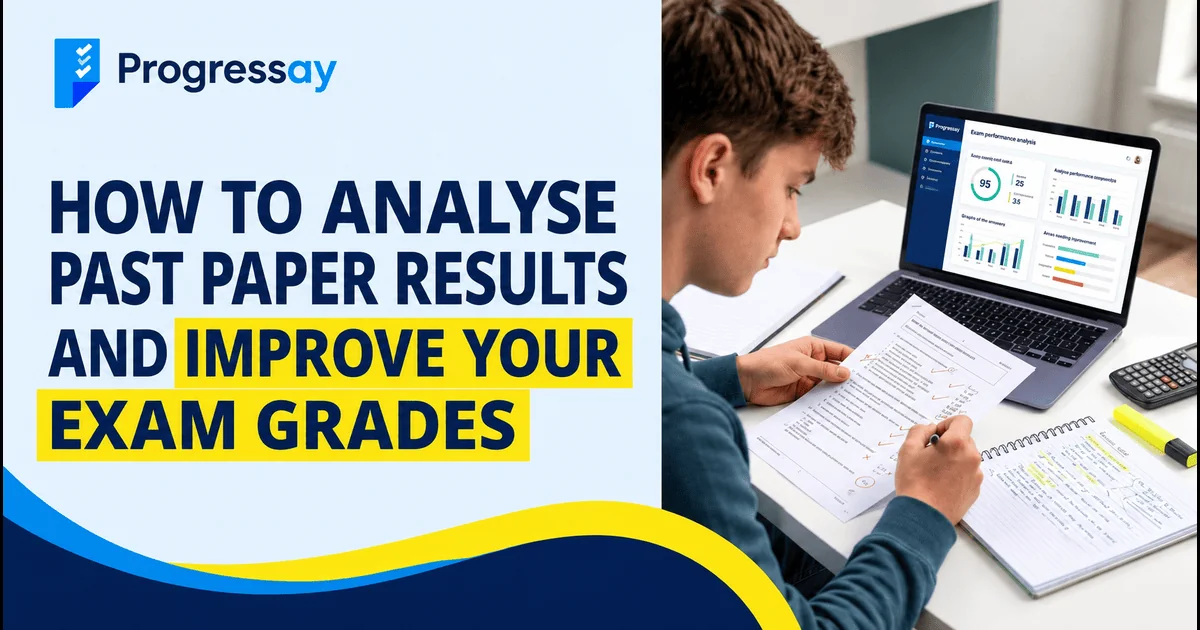
Completing a past paper is only the first step in exam preparation. The real improvement comes from understanding your mistakes, identifying weak topics and practising the skills you need to develop.
If you simply check your final score and move on to another paper, you could miss valuable opportunities to improve.
In this guide, you'll learn how to analyse past paper results, use mark schemes effectively and create a focused revision plan that helps you prepare for your GCSE exams.
Why Should You Analyse Your Past Paper Results?
Your past paper score tells you how you performed in one practice exam. Analysing your answers helps you understand why you received those marks and what you should work on next.
Reviewing your results can help you:
-
Identify topics you do not fully understand.
-
Recognise repeated mistakes.
-
Improve your exam technique.
-
Understand how marks are awarded.
-
Manage your time more effectively.
-
Plan more focused revision sessions.
The aim is not just to complete more exam papers. It is to learn something from every attempt.
How to Analyse Past Paper Results in 5 Steps
Follow these five steps after completing a GCSE past paper.
Step 1: Mark Your Answers Using the Mark Scheme
Start by checking your answers against the correct mark scheme for the paper and exam board.
Award marks honestly rather than giving yourself credit for answers that are only partly correct. For questions with method marks, check whether your working meets the marking requirements.
For each question, record:
-
Marks available.
-
Marks achieved.
-
What you got right.
-
What you missed or misunderstood.
You can find practice resources through the Progressay Past Papers collection.
Step 2: Identify Why You Lost Marks
Do not stop at identifying incorrect answers. Find out why each mistake happened.
Most mistakes fall into a few common categories:
| Mistake type | What it means | How to improve |
|---|---|---|
| Knowledge gap | You did not know or remember the topic | Revisit the topic and learn the key concepts |
| Misunderstanding | You misunderstood the question | Practise interpreting exam questions |
| Exam technique | You did not structure your answer correctly | Study model answers and marking guidance |
| Careless error | You made a calculation or reading mistake | Check your working and answers carefully |
| Time management | You ran out of time | Practise answering questions under timed conditions |
This classification helps you choose the right revision activity instead of repeating the same paper without addressing the problem.
Step 3: Look for Repeated Weak Topics
One incorrect answer does not always mean you are weak in a particular subject area.
Look across several questions and practice papers. Are you repeatedly losing marks on the same topic, question type or skill?
For example, a GCSE Maths student might notice the following pattern:
| Topic | Marks lost | Priority |
|---|---|---|
| Fractions | 4 | High |
| Algebra | 2 | Medium |
| Percentages | 5 | High |
| Geometry | 1 | Low |
This example suggests that fractions and percentages need more attention.
Create a list of your weakest topics and revise the highest-priority areas first.
Step 4: Understand the Mark Scheme and Improve Your Answers
Mark schemes are useful because they show how marks are awarded. Read the marking points carefully and compare them with your own responses.
For written subjects such as GCSE English, pay attention to how answers are developed, how evidence is used and how clearly ideas are explained.
For Maths and Science, check whether you included the correct method, working, units and final answer where required.
You can also use official examiner reports where available to understand common mistakes and areas where students lose marks. AQA provides past papers, mark schemes and examiner reports through its official assessment resources.
Do not simply copy the model answer. Try answering the question again without looking at the mark scheme.
Step 5: Create a Targeted Revision Plan
Once you understand your mistakes, turn them into specific revision tasks.
For example:
| Weak area | Revision activity | When to practise again |
|---|---|---|
| Fractions | Review methods and solve 10 questions | Tomorrow |
| Percentages | Practise exam-style questions | In 2 days |
| English analysis | Review a model answer and write your own | In 3 days |
| Time management | Complete a timed section | At the weekend |
Keep your revision goals realistic. Focus on a few weak areas at a time and check whether your accuracy improves when you practise again.
How to Track Your Progress Across Multiple Past Papers
Tracking your results helps you see whether your revision is working.
Use a simple record after every practice paper:
| Practice paper | Score | Main weakness | Next action |
|---|---|---|---|
| Paper 1 | 42/80 | Fractions | Revise fractions |
| Paper 2 | 48/80 | Percentages | Practise percentage questions |
| Paper 3 | 55/80 | Time management | Complete timed practice |
These are illustrative results, not predicted GCSE grades.
Look for improvements in your understanding and question accuracy, not just your total score. A higher mark is encouraging, but identifying and correcting repeated mistakes is equally important.
Can AI Help You Analyse Your Past Paper Answers?
AI tools can support your revision by reviewing written responses, explaining possible weaknesses and suggesting areas to practise.
For example, you can use an AI tool to:
-
Review a written answer and identify areas for improvement.
-
Explain why an answer may be incomplete.
-
Suggest practice questions for a weak topic.
-
Provide feedback on clarity, structure and vocabulary.
Progressay offers an AI Grading Assistant that can provide feedback on written work.
You can also read our guide to AI essay grading online to understand how AI-supported feedback can help with writing practice.
Remember that AI feedback may not match an official exam mark. Always check important answers against the relevant exam board's mark scheme and assessment requirements.
Common Mistakes Students Make When Reviewing Past Papers
Avoid these habits when analysing your exam practice:
-
Checking only the final score: Review individual questions to understand where marks were lost.
-
Ignoring the mark scheme: Use it to understand what a complete answer requires.
-
Repeating the same mistakes: Record errors and practise the relevant skills again.
-
Revising everything equally: Give more attention to topics where you consistently lose marks.
-
Never retesting yourself: Attempt similar questions later to check whether you have improved.
Frequently Asked Questions
How do you analyse past paper results?
Mark your answers using the correct mark scheme, identify why you lost marks, group mistakes by topic or skill and create a revision plan to address your weakest areas.
Should I analyse a past paper after every attempt?
Yes. Reviewing each completed paper helps you understand your performance and decide what to revise before attempting another one.
How many past papers should I complete before an exam?
There is no fixed number. Focus on completing papers regularly, reviewing your mistakes and practising weak topics. Quality of review is more important than completing papers without learning from them.
Should I use mark schemes when revising?
Yes. Mark schemes help you understand how marks are awarded and what examiners expect. Use the correct mark scheme for your exam board and specification.
What should I do if my past paper score is low?
Do not panic. Identify the topics and question types where you lost marks, revisit the relevant material and practise similar questions. Retest yourself after revision to measure improvement.
Final Thoughts
Past papers are more than a way to test your exam knowledge. They are an opportunity to discover what you understand, where you are losing marks and what you need to improve.
By marking your answers carefully, identifying repeated mistakes and creating a targeted revision plan, you can make every practice paper more useful.
Ready to practise? Explore GCSE past papers on Progressay, review your answers and take the next step towards better exam preparation.