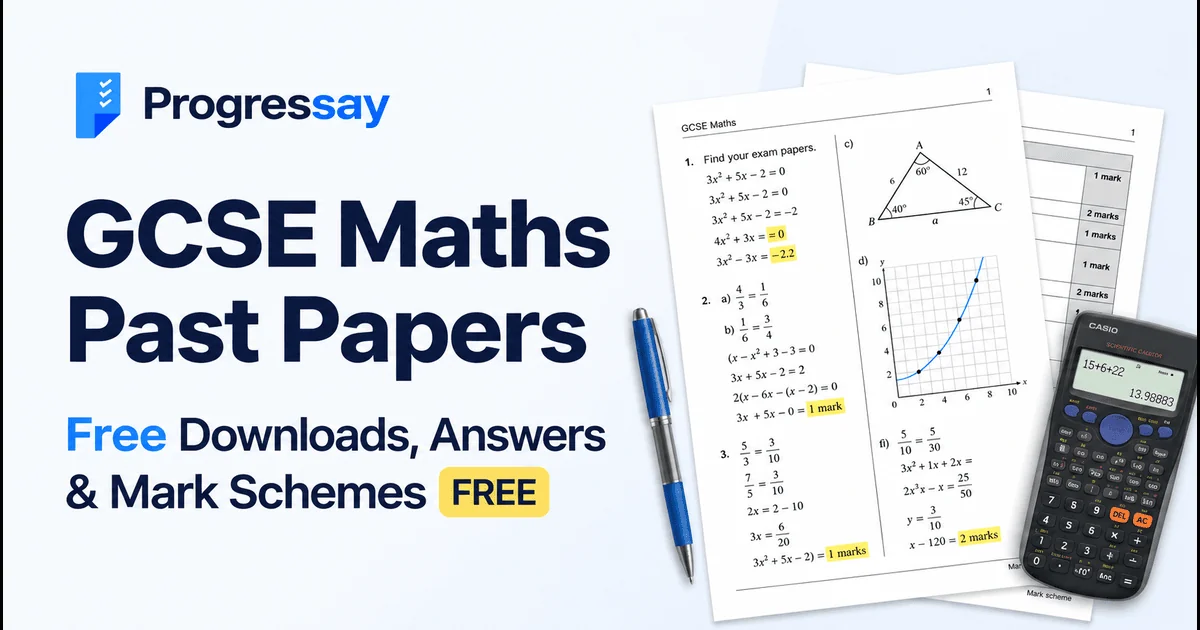
GCSE Maths Past Papers: Free Downloads, Answers and Mark Schemes
Preparing for GCSE Maths exams? Practising with GCSE Maths past papers is a useful way to understand exam questions, improve your problem-solving skills and identify the topics you need to revise.
Whether you are studying for AQA, Pearson Edexcel or OCR, this guide explains where to find past papers, how to use mark schemes and how to make your revision more effective.
Looking for practice papers? Explore Progressay's past papers and revision resources to find resources that support your exam preparation.
Where Can I Find Free GCSE Maths Past Papers?
You can find GCSE Maths past papers and mark schemes on official exam board websites. Start with the board you are studying, as question formats and specifications can differ.
| Exam board | Official past paper resources |
|---|---|
| AQA | GCSE Maths past papers and mark schemes |
| Pearson Edexcel | Edexcel past papers |
| OCR | OCR qualifications and assessment resources |
Most publicly available past papers and mark schemes can be accessed free of charge, although availability and access restrictions vary by exam board and exam series.
When choosing a paper, check that it matches your current GCSE Maths specification, exam board and tier.
What Are GCSE Maths Past Papers?
GCSE Maths past papers are question papers from previous exam sessions. They let you practise the types of questions you may encounter in your actual examination.
They can help you:
-
Understand the format and style of exam questions.
-
Practise applying mathematical methods under timed conditions.
-
Identify topics you find difficult.
-
Improve accuracy and problem-solving skills.
-
Learn how marks are awarded by checking the mark scheme.
-
Track your progress as you revise.
Past papers are most useful when you review your answers carefully rather than simply completing one paper after another.
GCSE Maths Foundation vs Higher Tier: Which Paper Should You Practise?
GCSE Maths generally has two tiers: Foundation and Higher. The appropriate tier depends on your exam entry.
Foundation tier: Designed for students entered for grades 1–5.
Higher tier: Designed for students entered for grades 4–9.
Always practise the tier you are entered for when completing full exam papers. If you are unsure, ask your maths teacher.
You can also practise individual topics to strengthen your understanding before attempting another complete paper.
How Many Papers Are There in GCSE Maths?
For the main GCSE Maths specifications offered by AQA, Pearson Edexcel and OCR, the standard examination consists of three written papers, although the paper numbering and format vary by board.
For example, AQA and Edexcel use three papers, including a non-calculator paper and two calculator papers. OCR uses different paper numbering for Foundation and Higher tiers.
Check your exam board's current specification to confirm the exact format, duration and requirements for your examination.
How to Use GCSE Maths Past Papers Effectively
Downloading a past paper is only the first step. Follow these five steps to make your practice more valuable.
1. Complete a paper under timed conditions
Choose a paper that matches your exam board and tier. Set a timer and try to complete the questions without checking your notes or looking up solutions.
This helps you practise managing your time and working independently.
2. Mark your answers carefully
Once you finish, compare your answers with the official mark scheme.
Do not check only the final answer. Look at the method marks and working required to earn credit. In maths, showing your steps can be important even when your final answer is incorrect.
3. Identify your weakest topics
Make a list of the questions you answered incorrectly or could not complete.
Your mistakes might relate to:
-
Fractions, percentages and ratio
-
Algebra and equations
-
Graphs and sequences
-
Geometry and angles
-
Probability
-
Statistics
-
Area, volume and measures
Focus on the topics that repeatedly cause problems.
4. Practise the topics you got wrong
Before attempting another full paper, revisit your weakest areas. Review the method, work through an example and then answer similar questions independently.
For extra practice, explore Progressay's past paper resources.
5. Repeat the process and track your progress
Keep a record of your scores and common mistakes. After revising your weak topics, attempt another suitable paper under timed conditions.
Compare your results over time to see whether your accuracy, confidence and time management are improving.
Common Mistakes to Avoid When Practising GCSE Maths Past Papers
Avoid these common revision mistakes:
-
Using the wrong exam board: Start with your own board's papers before using other boards for extra practice.
-
Ignoring the mark scheme: Understanding why an answer earns marks is as important as checking whether it is correct.
-
Skipping working: Write down your method clearly instead of recording only the final answer.
-
Repeating the same mistakes: Review incorrect answers and practise the underlying topic.
-
Only revising your strongest topics: Give extra time to areas where you regularly lose marks.
-
Practising without a timer: Include timed practice so you can learn to manage the examination duration.
A focused revision session that includes marking and correcting mistakes can be more valuable than completing several papers without reviewing them.
How Can GCSE Maths Past Papers Help You Prepare for Your Exams?
Past papers help you understand what you know and what you still need to improve. They also give you experience of working through different question types and allocating your time.
However, past papers cannot guarantee a particular grade or predict the exact questions in your next examination. Use them alongside your class notes, topic practice and your exam board's current specification.
Frequently Asked Questions About GCSE Maths Past Papers
Where can I download GCSE Maths past papers for free?
You can find publicly available GCSE Maths past papers on the official AQA, Pearson Edexcel and OCR websites. These sites also provide mark schemes for many available papers. You can explore Progressay's past papers page for additional revision resources.
Are GCSE Maths past papers available with answers?
Many past papers have accompanying mark schemes that show the expected answers and how marks are awarded. Check that the mark scheme matches the paper you are completing.
Should I practise Foundation or Higher GCSE Maths papers?
Practise the tier you are entered for. Foundation is designed for grades 1–5, while Higher is designed for grades 4–9. Your teacher can confirm your exam entry.
Are GCSE Maths past papers enough to revise for the exam?
Past papers are a valuable revision tool, but they should not be your only method. Combine them with topic revision, worked examples and targeted practice on questions you find difficult.
When should I start practising GCSE Maths past papers?
Start using individual past-paper questions once you understand the relevant topics. As your exam approaches, add full timed papers and carefully review your mistakes after each attempt.
Start Practising with GCSE Past Papers
The best way to get more from GCSE Maths past papers is to practise regularly, mark your answers honestly and use your mistakes to guide your next revision session.
Ready to get started?
Explore Progressay's Past Papers and find revision resources to support your exam preparation.
Practise with purpose, strengthen your understanding and work towards your GCSE Maths goals.