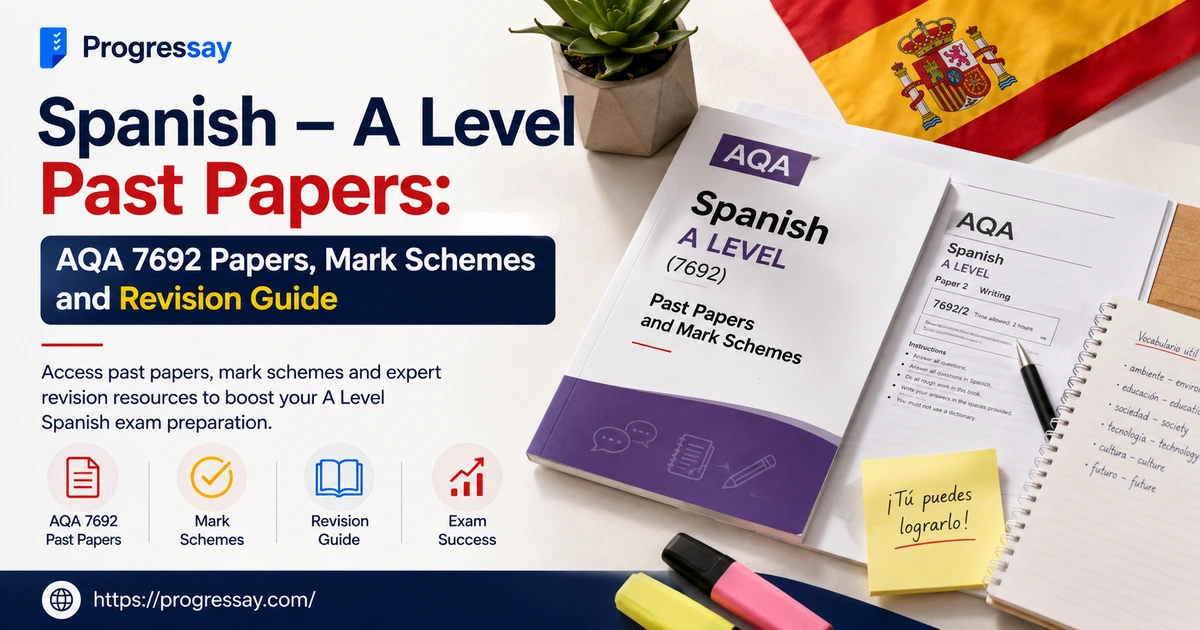
Spanish – A Level Past Papers: AQA 7692 Papers, Mark Schemes and Revision Guide
Preparing for A Level Spanish can feel very different from revising for other subjects. You need to understand spoken Spanish, read unfamiliar texts, write accurately, analyse cultural topics and express your ideas confidently. That is why AQA Spanish A Level past papers are one of the most useful resources you can add to your revision routine.
If you're studying AQA A Level Spanish (7692) and looking for past papers, mark schemes and exam practice, Progressay brings the available papers together in one organised place.
👉 Explore Spanish – A Level Past Papers on Progressay
The collection currently includes 12 AQA Spanish A Level past papers from 2020 to 2024, organised by paper and year. You can find Paper 1 and Paper 2 question papers alongside their mark schemes and relevant inserts.
What Are AQA A Level Spanish Past Papers?
AQA A Level Spanish past papers are previous examination papers for AQA specification 7692. They allow students to practise the types of questions, language skills and exam techniques they will need for their A Level Spanish examination.
The AQA qualification is assessed across three components:
-
Paper 1: Listening, Reading and Writing
-
Paper 2: Writing
-
Paper 3: Speaking
According to AQA, Paper 1 is worth 50% of the qualification, Paper 2 is worth 20%, and Paper 3 is worth 30%. Paper 1 has a maximum raw mark of 100 and lasts 2 hours 30 minutes, while Paper 2 has a maximum raw mark of 80 and lasts 2 hours.
This means past-paper practice is not just about answering questions. It is about becoming comfortable with the specific demands of the AQA Spanish exam.
Where Can I Find AQA Spanish A Level Past Papers?
You can access the Progressay collection here:
👉 Spanish – A Level Past Papers | Progressay
The page is organised so that you can quickly filter the available papers by Paper 1, Paper 2 and examination year. The current collection includes papers from 2020, 2021, 2022, 2023 and 2024, as well as specimen material.
This makes it much easier to find the exact paper you want instead of searching through multiple websites for individual PDFs.
AQA Spanish A Level Paper 1 Past Papers
Paper 1 is Listening, Reading and Writing.
This paper tests several important skills, including your ability to understand spoken Spanish, interpret written information and communicate accurately in Spanish.
Progressay currently includes AQA Spanish Paper 1 materials for:
-
Specimen Papers
-
2024
-
2023
-
2022
-
2021
-
2020
For the available papers, you can access the question paper, mark scheme and insert where provided.
How to Practise Paper 1
Don't simply complete Paper 1 and check your final score.
Instead, break your revision into three stages:
1. Listening
Listen carefully to the recording and identify where you lost marks. Was it vocabulary, speed, unfamiliar accents or failure to understand the context?
2. Reading
Look at the questions you got wrong and identify the reason. Did you misunderstand the question, miss a detail or misinterpret a Spanish expression?
3. Writing
Pay attention to grammar, vocabulary and the way you construct your answers. A correct idea can still lose marks if your Spanish is inaccurate or lacks the range expected at A Level.
AQA's assessment criteria place significant importance on accurate language, vocabulary and the ability to manipulate more complex language.
AQA Spanish A Level Paper 2 Past Papers
Paper 2 focuses on Writing.
This is particularly important for students who need to improve their essay technique.
The Progressay collection currently includes Paper 2 materials from:
-
Specimen Papers
-
2024
-
2023
-
2022
-
2021
-
2020
The page provides the relevant question papers and mark schemes for the available years.
AQA recommends approximately 300 words per essay for Paper 2, although there is no fixed word limit. The assessment considers both language and the quality of the student's critical and analytical response.
How to Improve Your Paper 2 Essays
Before starting an essay, spend a few minutes planning:
-
What is the question actually asking?
-
What is your main argument?
-
Which examples will support your argument?
-
What cultural or contextual knowledge can you use?
-
Which Spanish structures can help you express your ideas clearly?
After completing the essay, don't immediately move on to another paper.
Use the mark scheme to identify:
-
Grammar mistakes
-
Limited vocabulary
-
Repeated sentence structures
-
Weak arguments
-
Missing evidence
-
Poorly developed opinions
-
Areas where your cultural knowledge could be stronger
This process is much more valuable than simply counting how many questions you answered correctly.
Why Should You Use AQA Spanish Past Papers?
1. Understand the AQA Exam Format
One of the biggest advantages of past papers is familiarity.
When you have seen the exam format several times, the actual exam feels less unfamiliar. You know what types of questions to expect and can concentrate more on demonstrating your Spanish ability.
2. Identify Your Weak Areas
A past paper can reveal problems that normal revision might hide.
For example, you may discover that:
-
You understand Spanish well but struggle with listening.
-
Your vocabulary is good but your grammar needs work.
-
You can answer comprehension questions but struggle with summaries.
-
Your essays contain good ideas but lack detailed analysis.
-
You know the content but lose marks because of exam technique.
Once you identify the problem, your revision becomes much more focused.
3. Practise Under Realistic Time Conditions
Knowing the material is only part of exam preparation.
You also need to complete the paper within the available time.
Try completing a past paper without checking your notes or using a dictionary. Put your phone away, set a timer and treat the session like the real examination.
This helps you develop the ability to make decisions quickly when you are under pressure.
4. Learn From the Mark Scheme
The mark scheme should not be something you look at only after finishing an exam.
It can teach you what the examiner is looking for.
AQA's assessment criteria cover areas including understanding and responding to language, accurate manipulation of Spanish and knowledge and understanding of the culture and society of Spanish-speaking countries and communities.
The more familiar you become with these expectations, the easier it becomes to recognise what separates a basic answer from a stronger one.
A Better Way to Use Spanish A Level Past Papers
If you have several papers available, avoid completing every paper consecutively just to increase the number of papers you have finished.
Try this approach instead.
Step 1: Start With an Untimed Paper
If you haven't done many AQA Spanish past papers, begin without worrying too much about the clock.
Focus on understanding the questions and identifying areas where you struggle.
Step 2: Analyse Your Mistakes
Create a simple mistake log.
For every lost mark, record:
Question → Mistake → Reason → Correct approach
For example:
Reading Question → Misunderstood a phrase → Vocabulary issue → Add phrase to vocabulary revision list
This turns each past paper into a personalised revision resource.
Step 3: Revise Your Weak Areas
Don't revise everything equally.
If three consecutive papers show that you struggle with listening questions, spend more time practising listening.
If your essays consistently lose marks because of grammar, focus on grammar and sentence construction.
Step 4: Start Timed Practice
Once you understand the exam format, start completing papers under realistic time conditions.
This is where you begin developing exam speed and consistency.
Step 5: Repeat the Process
Complete another paper, review your mistakes and compare your results.
The goal isn't simply to complete more papers.
The goal is to make fewer mistakes each time you complete one.
How Many AQA Spanish Past Papers Should You Do?
There is no magic number that guarantees a particular grade.
Quality matters more than quantity.
Completing five papers carefully, analysing your mistakes and revising your weaknesses can be more useful than completing ten papers without reviewing your answers.
A good approach is to gradually work through the available AQA Spanish A Level past papers and use each one to improve a specific skill.
For example:
First paper: Understand your starting point.
Second paper: Focus on weak areas.
Third paper: Improve timing.
Fourth paper: Concentrate on accuracy.
Fifth paper: Simulate the real examination.
You can then repeat this process with additional papers.
Should You Use the Mark Scheme After Every Past Paper?
Yes.
The mark scheme is an important part of past-paper practice because it helps you understand why an answer received a particular mark.
For Paper 1, you can analyse where you lost marks in listening, reading and written responses.
For Paper 2, pay particular attention to language accuracy, vocabulary, argument development and cultural knowledge.
Don't just look at the correct answer and move on.
Ask yourself:
“What would I need to change in my answer to gain the mark next time?”
That question turns passive revision into active learning.
AQA Spanish 7692: Know Your Exam
If you're preparing for AQA Spanish 7692, it is worth becoming familiar with the official assessment structure as well as practising past papers.
AQA describes the qualification as a linear course, with all assessments completed at the end of the course. The specification covers areas including social issues and trends, political and artistic culture, grammar, works and an individual research project.
This means your revision should combine:
-
AQA Spanish past papers
-
Mark schemes
-
Grammar practice
-
Vocabulary building
-
Listening practice
-
Reading practice
-
Essay practice
-
Speaking practice
-
Cultural and historical knowledge
Past papers are one part of the preparation, but they become much more effective when combined with the rest of your revision.
Start Practising AQA Spanish A Level Past Papers
If you're looking for Spanish A Level past papers, you don't need to spend your revision time searching for individual papers across different websites.
Progressay's AQA Spanish A Level collection brings the available papers together in one place, organised by paper and year.
👉 View Spanish – A Level Past Papers on Progressay
Choose a paper, practise under realistic conditions, check your answers against the mark scheme and make a note of every mistake.
Then do it again.
The aim isn't to become familiar with one particular paper. It's to become familiar with the skills, question styles and exam demands so that you feel more confident when you walk into the real A Level Spanish examination.
Ready to Practise?
Don't wait until the final weeks before your exam to start using past papers.
Build them into your revision routine, learn from your mistakes and gradually improve your accuracy, timing and confidence.
👉 Start practising with Spanish – A Level Past Papers on Progressay
Frequently Asked Questions
What is the AQA A Level Spanish exam code?
The exam code for AQA A Level Spanish is 7692.
Where can I find AQA Spanish A Level past papers?
You can find the available AQA Spanish A Level past papers on the Progressay Spanish A Level Past Papers page, organised by paper and year.
👉 Access the past papers on Progressay
What years of AQA Spanish A Level past papers are available on Progressay?
The current Progressay collection lists papers from 2020, 2021, 2022, 2023 and 2024, together with specimen papers.
What is AQA Spanish Paper 1?
AQA Spanish Paper 1 is Listening, Reading and Writing. It has a maximum raw mark of 100 and is worth 50% of the qualification.
What is AQA Spanish Paper 2?
AQA Spanish Paper 2 is the Writing component. It has a maximum raw mark of 80 and contributes 20% of the qualification.
Is the AQA Spanish A Level exam difficult?
The difficulty depends on your current Spanish ability, preparation and familiarity with the exam format. Regular practice can make the exam format more familiar and help you identify areas that need improvement.
How can I improve my AQA Spanish A Level grade?
Combine regular past-paper practice with vocabulary development, grammar revision, listening practice, reading, essay writing and speaking practice. Most importantly, review your mistakes after every past paper rather than simply moving on to the next one.
Are past papers enough for A Level Spanish revision?
Past papers are extremely useful, but they should not be your only revision resource. Use them alongside your class notes, specification, grammar resources, vocabulary practice and cultural study.
When should I start doing AQA Spanish past papers?
Start with past papers once you have covered enough of the course to understand the material being tested. Begin with untimed practice if necessary, then move towards full timed examinations as your exam approaches.