
How to Answer Exam Questions with AI: The Command Word Method
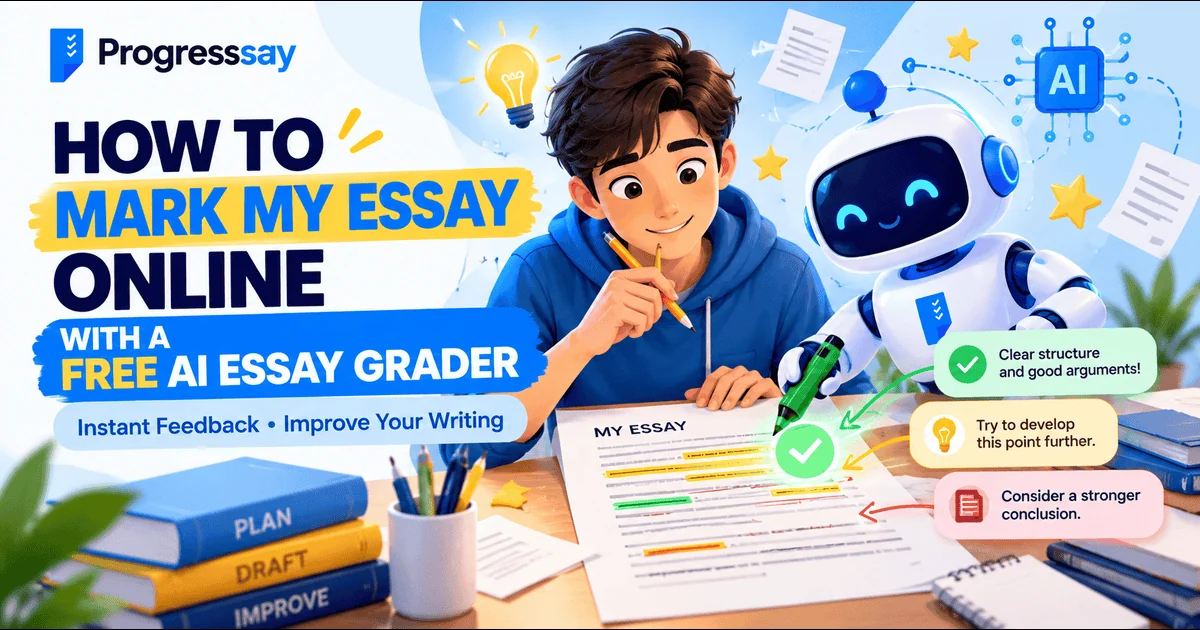
Struggling to understand what an exam question is asking? You might know the topic but still lose marks because your answer does not do exactly what the question requires. Try Progressay’s AI Grading Assistant to get AI-assisted feedback on your written answers and identify areas to improve.
The solution is to understand command words. Words such as explain, analyse, compare, evaluate and discuss tell you what kind of response you need to produce.
You can also use AI as a revision partner to practise command words, structure stronger answers and identify areas for improvement.
In this guide, you will learn a simple method for answering exam questions, see practical examples and discover how to use AI to improve your exam technique.
What Are Exam Command Words?
Exam command words are instructions that tell you what to do in your answer. They help you understand whether you need to give a short fact, explain a reason, analyse evidence or make a supported judgement.
For example:
-
State: Give a clear, brief answer.
-
Describe: Set out the main features or characteristics.
-
Explain: Give reasons or show how something happens.
-
Compare: Identify relevant similarities and differences.
-
Analyse: Break information down and explain what it shows.
-
Evaluate: Judge the value, effectiveness or importance of something using evidence.
-
Discuss: Explore relevant points or different perspectives in a structured answer.
-
Justify: Support a choice or argument with reasons and evidence.
These are general explanations. The precise expectation depends on the subject, exam board and wording of the question. Always follow the full question and your course's assessment guidance.
The Command Word Method: A Simple Way to Answer Exam Questions
Use this five-step method whenever you practise an exam question.
Step 1: Identify the command word
Read the entire question and identify its main instruction.
For example:
“Explain two reasons why exercise is important for health.”
The command word is explain. This means you should give reasons, not simply list two benefits.
Step 2: Understand what the question requires
Ask yourself:
-
What exactly am I being asked to do?
-
How many points or examples do I need?
-
Must I use evidence from a source?
-
Does the question require a judgement or conclusion?
-
How many marks are available?
The marks can help you judge the expected depth, but they do not create a universal rule for how many sentences to write.
Step 3: Plan your answer
Before writing, identify the main point you want to make.
For a question asking you to explain why exercise benefits health, you might plan:
-
Point 1: Exercise strengthens the heart.
-
Reason: The heart works harder during physical activity.
-
Result: Regular activity can improve cardiovascular fitness.
A short plan helps you stay focused on the question.
Step 4: Answer using relevant evidence
Make your point, support it with evidence or an example where appropriate, and explain how it answers the question.
For source-based English questions, use relevant quotations or references from the text. For science, use accurate subject knowledge. For maths, show the necessary working.
The right structure depends on the question; avoid adding irrelevant information just to make your answer longer.
Step 5: Check your answer against the question
Before moving on, ask:
-
Have I followed the command word?
-
Have I answered every part of the question?
-
Have I included relevant evidence or working?
-
Have I explained my reasoning where required?
-
Have I made a judgement if the question asks me to evaluate?
This final check can help you spot incomplete answers before you submit your work.
Analyse vs Explain vs Evaluate: What Is the Difference?
These command words are easy to confuse, but they generally require different approaches.
| Command word | What to do | What a strong answer includes |
|---|---|---|
| Explain | Give reasons or show how something happens | A clear point and supporting reasoning |
| Analyse | Examine information in detail and explain what it reveals | Evidence, interpretation and relevant connections |
| Evaluate | Make a supported judgement | Evidence, strengths or limitations where relevant, and a reasoned conclusion |
| Compare | Identify similarities and differences | Relevant points about both things being compared |
| Discuss | Explore relevant points or perspectives | A structured explanation of the key issues |
Example: Explain
Question: Explain why regular exercise can improve health.
Example answer: Regular exercise can improve cardiovascular fitness because it makes the heart work harder to deliver oxygen around the body. Over time, regular physical activity can help the cardiovascular system work more efficiently.
Why it works: The answer identifies a benefit and explains the reason behind it.
Example: Analyse
Question: Analyse how a writer presents a character as anxious.
Example answer: The writer's description of the character's trembling hands suggests physical fear. This detail allows the reader to infer that the character feels unable to control their emotions, creating a sense of tension.
Why it works: The answer uses a textual detail and interprets how it shapes the reader's understanding. In a real English exam, use an accurate quotation from the source.
Example: Evaluate
Question: Evaluate whether online learning is effective for students.
Example answer: Online learning can be effective because students can revisit lessons and study at their own pace. However, some students may struggle without direct support from a teacher. Overall, its effectiveness depends on the student's needs, the quality of the resources and the support available.
Why it works: The answer considers relevant benefits and limitations before reaching a reasoned judgement.
These examples demonstrate general exam technique. They are not guaranteed full-mark answers; the marking criteria and subject-specific requirements determine the quality of a real exam response.
How to Use AI to Practise Exam Questions
AI can help you practise command words and review your answers before an exam. The most useful approach is to give the AI the exact question, your answer and any relevant mark scheme or assessment criteria.
Here are four ways to use it.
1. Ask AI to explain the command word
If you do not understand a question, ask AI to explain the instruction in simple language.
Prompt to copy:
“Explain what the command word in this exam question requires me to do. Break down the question into simple steps. Do not answer the question for me. Explain what a good answer should include.”
2. Practise with exam-style questions
Ask AI to generate practice questions for a particular subject and difficulty level.
Prompt to copy:
“Create five practice questions for my GCSE [subject] course. Include a mixture of command words, such as explain, analyse, compare and evaluate. Give each question a suggested mark allocation and explain what skills it tests. Keep the questions appropriate to my exam board and specification.”
Check the questions against your current specification because AI-generated questions may not match the exact format of your exam.
3. Ask AI to review your answer
Write your answer independently first. Then ask AI to review it using the official mark scheme or assessment criteria, if available.
Prompt to copy:
“Review my answer against the mark scheme or assessment criteria I provide. Identify what I did well, what is missing, and which parts of my answer need improvement. Give specific reasons for your feedback. Do not invent marks or claim that you are an official examiner.”
AI feedback can help you spot weaknesses, but it may misinterpret a question or marking criterion. Check important feedback against your teacher's guidance and the official mark scheme.
4. Rewrite your answer and compare
After receiving feedback, improve your own answer. Compare the original and revised versions to see whether you have answered the command word more effectively.
This process encourages active learning rather than simply copying an AI-generated response.
Can AI Help You Get Better Exam Grades?
AI can support revision by explaining difficult concepts, generating practice questions and providing feedback on written answers. It can also help you recognise when you have described something but have not explained it, or when you have given an opinion without supporting it with evidence.
However, AI cannot guarantee a higher grade. Its feedback may be inaccurate, and its suggested answers may not reflect the precise requirements of your exam board.
For the best results:
-
Attempt questions independently.
-
Check your work against the official mark scheme.
-
Use AI to understand mistakes and explore improvements.
-
Rewrite weak answers in your own words.
-
Repeat the process with new questions.
Practise Your Exam Technique with Progressay
Understanding command words is only one part of successful revision. You also need opportunities to practise questions, review your answers and learn from mistakes.
Progressay offers resources to help students develop their exam preparation skills.
-
Try the Progressay AI Grading Assistant to explore AI-assisted feedback on written work.
-
Explore free past papers and revision resources to practise with available exam materials.
Use feedback as a learning aid, and compare your work with the relevant mark scheme wherever possible.
Frequently Asked Questions
What are command words in exams?
Command words are instructions that tell you how to approach a question. Examples include explain, analyse, compare, evaluate and describe. Their precise meaning can depend on the subject and exam board.
How do I answer an analyse question?
Examine the relevant information, select supporting evidence and explain what that evidence reveals. In English, this may involve analysing a writer's language or structure; in other subjects, it may involve interpreting data or identifying relationships.
What is the difference between analyse and evaluate?
Analyse means examining information in detail and explaining its meaning or significance. Evaluate means making a reasoned judgement based on relevant evidence. Some questions require both analysis and evaluation.
Can I use AI to mark my exam answers?
You can use AI to review practice answers and suggest improvements. However, AI feedback is not an official grade and may be inaccurate. Use the relevant exam board's mark scheme and assessment criteria to check your work.
Can AI help me prepare for GCSE exams?
Yes. AI can explain command words, create practice questions, help you plan answers and provide feedback. You should still practise independently and verify important information against your specification and official resources.
Final Tip: Answer the Question, Not Just the Topic
A strong exam answer does more than show what you know. It responds directly to the instruction, supports its points with relevant evidence or reasoning, and includes the level of detail the question requires.
Use the command word method every time you practise. Then use mark schemes, teacher feedback and AI-assisted revision to identify what to improve next.
Ready to practise? Visit Progressay's AI Grading Assistant or explore free past papers to support your revision.